

As Australia charts its course towards a submarine-dominated future anchored by nuclear propulsion, a parallel revolution is quietly gathering force below the surface, one driven not by platforms alone, but by the relentless acceleration of innovation across sensing, autonomy, artificial intelligence and distributed systems.
This convergence represents nothing short of a paradigm shift in how the Royal Australian Navy will project power and defend national interests across the Indo-Pacific.
For the Australian defence establishment, the challenge is acute. The underwater domain, as one senior naval leader notes during recent industry discussions, “is becoming more contested, more congested” while simultaneously “becoming more connected with other parts of the maritime domain”.
That statement captures the essential tension driving current strategy: the complexity of the operating environment is multiplying faster than traditional acquisition pathways can respond. Enter innovation not as an optional enhancement, but as the foundational architecture upon which credible undersea capability must be built.
Dr Ninh Duong, Australia’s chief of air and maritime in the Defence Science and Technology Group, frames the challenge with particular clarity. Having observed firsthand the innovation ecosystem of Silicon Valley during his posting to Washington, Duong sees the imperative in starkly contemporary terms.
“The speed and rate at which technology is evolving is just absolutely mind boggling,” he says, before articulating a critical insight for Australian strategists: the future does not belong to those developing singular breakthroughs, but to those orchestrating “the convergence of the technologies” and being “smarter in how we use those technologies”.
This emphasis on integration and speed sits at the heart of what Australian defence is attempting to achieve. The AUKUS Pillar 2 program, which underwrites the technology enhancement ecosystem of the Australia-UK-US partnership, is explicitly designed as an innovation incubator.
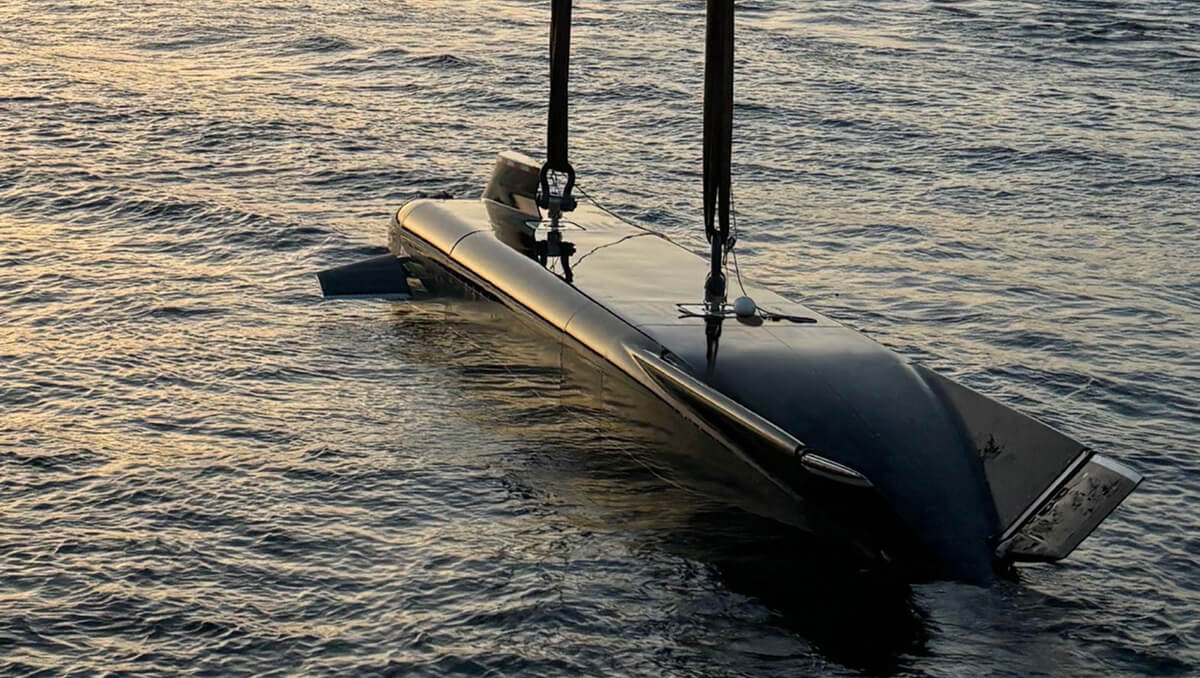
Yet the real achievement will not be measured in the specifications of individual platforms – the Ghost Shark uncrewed underwater vehicles, the Speartooth systems, or the Bluebottle surface vessels – that have captured international attention.
Rather, it will be measured in the speed at which Australia can develop, test, iterate and operationalise the underlying systems that bind these capabilities into a coherent whole.
For Rear Admiral (Ret’d) Stephen Hughes, the outgoing chief of Navy Capability, this insight translates into operational doctrine. In discussing the future force structure, he emphasises that the transition to an autonomous-augmented fleet cannot be understood through the lens of platform competition.
“The platform is what I call the simpler bit of it,” Hughes says. What matters far more is “the common control architecture, it’s the payloads, it’s the sensor systems”. This reframing is deceptively important: it signals that Australia’s competitive advantage in undersea warfare will rest not on producing the best autonomous vehicle, but on producing the best system within which multiple capabilities crewed and uncrewed can operate with speed and coherence.
The innovation challenge here is multifaceted. The first dimension concerns sensing and persistent surveillance. Both Hughes and Duong point to advances in low-cost sensor proliferation and edge processing, the ability to conduct data analysis closer to the point of collection as fundamental enablers of a distributed undersea architecture.
“The rise of low-cost sensors, advances in our ability to distribute those sensors across the battle space, significant improvements in processing at the edge” represent, in Duong’s assessment, the leading edge of how technology is reshaping undersea warfare.
This is not the preserve of exotic, high-classification programs. These are largely dual-use capabilities being developed by commercial actors across mining, energy and telecommunications sectors. The innovation imperative is learning to translate and integrate these capabilities into military effect.
The second dimension concerns what Hughes terms “trusted autonomy”, the algorithmic and governance frameworks that allow uncrewed systems to operate with appropriate degrees of independence while maintaining human oversight and control. This is where innovation intersects with doctrine, policy and ethics.
Hughes is explicit: “I don’t see a world of all these things running around making their own decisions, shooting things by themselves. That’s not how we fight as a defence force.” Yet the operational requirement is clear: as the underwater domain becomes more transparent through advancing sensor networks, the platforms operating within it must be able to respond faster than humans can process the data flowing across the network.
This paradox requiring autonomous decision making while maintaining ultimate human control will define much of the innovation agenda for the next decade.
The third dimension concerns ecosystem velocity. Here, Duong’s final observations prove particularly incisive.
The constraint on Australian defence innovation is not research capability by global standards; Australia punches well above its weight in defence-related research and development.
Rather, the constraint is “the translation piece ... moving that R and D into product and commercial success.” Australian research institutions routinely develop world-class concepts that then languish in valleys of death, unable to cross from laboratory prototype to operational capability to commercial scale.
For Australian defence to maintain technological edge in undersea systems, the innovation ecosystem must become genuinely integrated with funding mechanisms, governance structures and policy incentives all aligned towards continuous iteration from laboratory through to deployed capability.”
“It’s really about how do we supercharge our innovation ecosystem and connect all the different parts of it from the R and D all the way into the capability delivery,” Duong says. The current system, he observes, is characterised by silos: research institutions hand off to prototyping teams, who hand off to industry partners, who hand off to acquisition agencies.
“Every time there’s a gap, there is a lot of extra work and effort in terms of redoing the integration piece.” For Australian defence to maintain technological edge in undersea systems, the innovation ecosystem must become genuinely integrated with funding mechanisms, governance structures and policy incentives all aligned towards continuous iteration from laboratory through to deployed capability.
It is in this ecosystem integration where the Orca partnership may yet deliver its most valuable dividend. By creating a common architecture within which Australian, British and American capabilities can be integrated, tested and refined, the partnership provides the necessary scale to validate experimental technologies and accelerate their operational adoption.
“We’re all using our sovereign capability and that investment from our partners and we all leverage off that,” Hughes says. The payload development, command-and-control systems, and sensor fusion algorithms being developed across the Orca nations create a multiplier effect – Australia need not develop all capabilities domestically but can accelerate their adoption by leveraging allied innovation.
Yet speed alone is insufficient. The Royal Australian Navy must also preserve strategic autonomy – the capacity to develop and operate undersea capabilities that are not dependent on allied permission or architecture.
This is the genuine tension underlying debates about Australia’s Ghost Shark, the UK’s Excalibur and America’s Orca: not competition between platforms, but calibration of the investment between proprietary Australian capability and interoperable alliance systems.
For a maritime nation confronting an increasingly contested Indo-Pacific, the answer cannot be either/or. It must be both platforms that are distinctly Australian in conception and operation, married to systems and algorithms developed alongside our most trusted partners.
The innovation challenge is not technological. It is organisational, cultural and political: the willingness to integrate what have historically been separate domains of research, development and acquisition into a seamless continuum.
That integration will be the true measure of whether Australian defence can maintain relevance in undersea warfare across the decades ahead.