

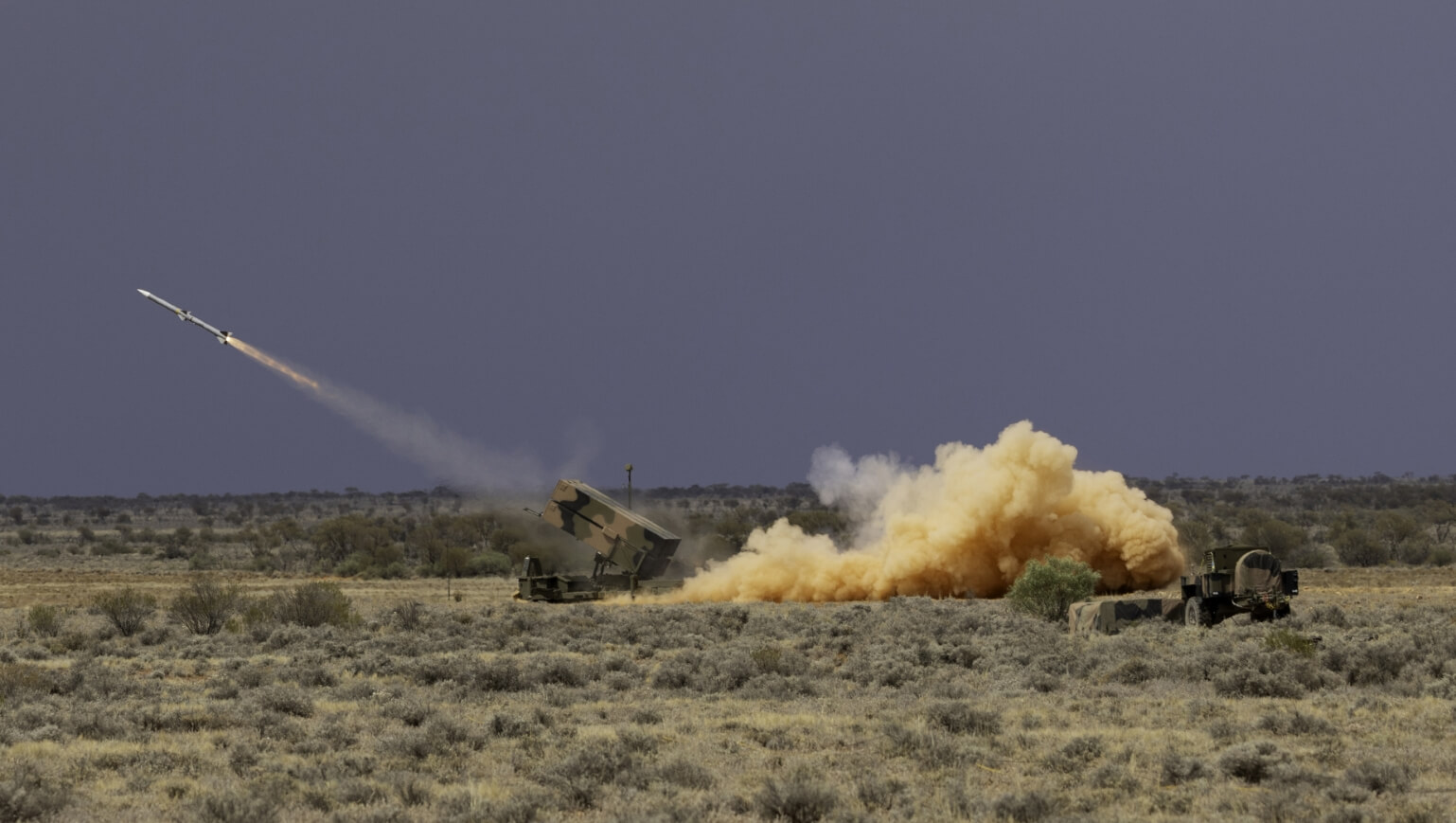
China’s rapid expansion of anti-access/area-denial (A2/AD) capabilities, including hypersonic glide vehicles and intermediate-range ballistic missiles capable of striking northern Australia from the South China Sea, has transformed the region’s strategic calculus.
For the Australian Defence Force, the ability to protect the homeland, forward bases hosting growing US rotational forces, and critical infrastructure is no longer a luxury. It is existential.
Yet Australia’s layered integrated air and missile defence (IAMD) remains a glaring gap, despite repeated calls for urgency in the 2023 Defence Strategic Review (DSR) and the 2024 National Defence Strategy (NDS).
As the three AUKUS partners prepare for the next phase of their partnership – with the 2026 Australian NDS and Integrated Investment Program (IIP) update looming – elevating IAMD to a marquee focus within Pillar 2 is not merely desirable.
It is now an inescapable imperative.
Doing so would harness the partnership’s advanced capabilities mandate to deliver tangible, interoperable systems that complement the nuclear-powered submarines of Pillar 1, strengthen deterrence by denial and bind the United States, the United Kingdom and Australia in a shared shield against the very threats driving the alliance.
Future-focused capabilities
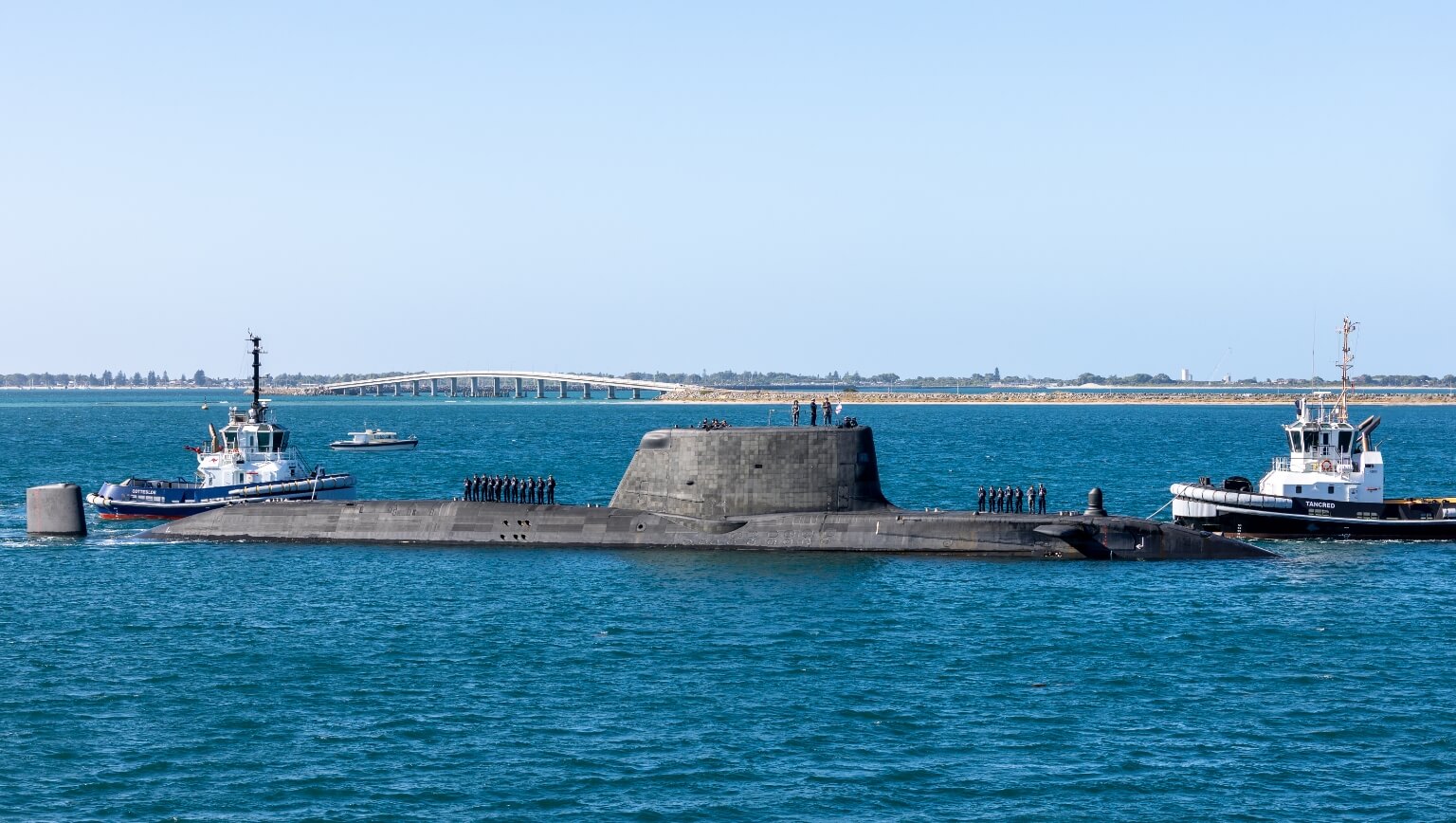
Pillar 2 was initially conceived as the revolutionary counterpart to Pillar 1’s generational submarine project.
Announced in 2021 and expanded in 2022, it targets collaboration in artificial intelligence and autonomy, quantum technologies, hypersonics and counter-hypersonics, electronic warfare, cyber, undersea capabilities, innovation and information sharing.
Progress has been real: autonomous sensing trials under the Resilient and Autonomous Artificial Intelligence Technology (RAAIT) initiative, hypersonic flight-test agreements, and export-control reforms that ease technology transfer.
Yet as senior US analysts Abraham Denmark and Charles Edel have warned in their August 2025 Center for Strategic International Studies (CSIS) report, The AUKUS Inflection, the eight workstreams risk becoming “too broad and unfocused”. Without two or three “marquee capabilities” that deliver rapid warfighter lethality, Pillar 2 could fade into irrelevance.
IAMD is the obvious third marquee priority alongside autonomy and long-range strike.
A recent CSIS analysis explicitly recommended concentrating Pillar 2 on these three areas because they represent “critical requirements for each nation” and will “substantially increase deterrence in both Europe and the Indo-Pacific”.
Malcolm Davis of the Australian Strategic Policy Institute has echoed the call, noting that Pillar 2 “should be expanded to IAMD, even though it is not now a priority technology area in AUKUS”.
The strategic logic is compelling.
The DSR was blunt: “Defence must deliver a layered integrated air and missile defence operational capability urgently” and “missile defence capabilities should be accelerated”.
The review criticised the existing program’s structure for pursuing a “long-term near-perfect solution at an unaffordable cost” rather than a minimum viable capability quickly.
Two years on, progress remains incremental. The government has allocated $74 billion over the decade to long-range strike and integrated missile defence and continues work on AIR 6500 (the Joint Air Battle Management System).
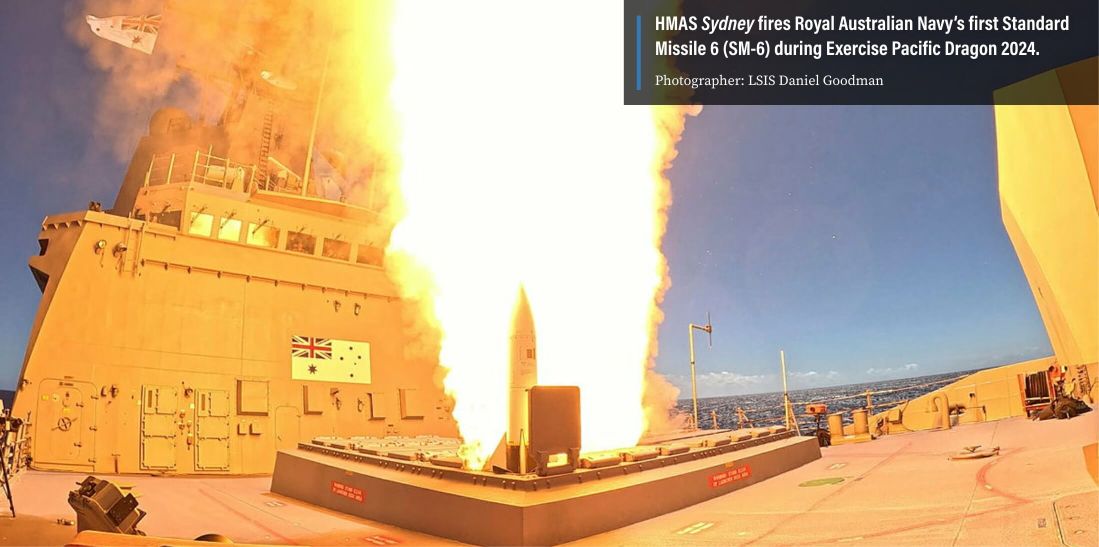
Australia is the second nation after the US to test-fire the SM-6 missile and is acquiring significant numbers.
Yet acquisition of proven interceptor systems has been deferred until after the 2026 IIP update, despite off-the-shelf options being immediately available.
This delay is untenable. Contemporary conflicts – Ukraine’s drone swarms, Houthi missile barrages in the Red Sea, and the proliferation of cheap cruise and ballistic threats – have demonstrated that air and missile defence is the persistent backbone of any credible denial strategy.
Contemporary conflicts – Ukraine’s drone swarms, Houthi missile barrages in the Red Sea, and the proliferation of cheap cruise and ballistic threats – have demonstrated that air and missile defence is the persistent backbone of any credible denial strategy.”
For Australia, the vulnerability is acute. Northern bases at Darwin and Tindal are expanding to host US Marines, bombers, fighters and intelligence, surveillance and reconnaissance aircraft under enhanced force-posture arrangements.
A January 2026 US National Defence Strategy has explicitly demanded more from Australia, including “effective integrated air and missile defence to protect key facilities in the north”. As the CSIS report noted, “it should not be up to the United States to defend Australian military bases in the north of the continent”.
IAMD under AUKUS Pillar 2 would address this precisely by creating a trilateral “networked air defence architecture” language already used in the US-Japan-Australia statement of April 2024.
It would integrate sensors, command-and-control networks, battle-management systems and interceptors into a layered, multi-domain shield: short-range systems for unmanned aerial vehicles and cruise missiles, medium-range ground-based air defence (GBAD) for tactical ballistic threats, and advanced capabilities against hypersonics.
Avenues for collaboration and integration are rich and ready to be accelerated.
The true strength of AUKUS: Industrial collaboration and integration
First, technical integration leveraging existing Pillar 2 streams.
Counter-hypersonic work is already under way; linking it explicitly to IAMD through shared testing ranges (the Hypersonic Flight Test and Experimentation project has $252 million allocated and six campaigns scheduled by 2028) would create a seamless kill chain.
Artificial intelligence and autonomy trials such as the RAAIT deployments at Project Convergence have already demonstrated AI-enabled sensing for faster target identification and intercept allocation.
Extending these to IAMD track-data analysis and automated fire control would multiply effectiveness.
Electronic warfare (EW) synergies are obvious: degrading adversary IAMD is already a priority for the ADF via the Advanced Strategic Capabilities Accelerator, but defensive EW to protect our own systems fits naturally within Pillar 2.
Second, sensor and data-sharing networks. Australian active electronically scanned array radar technologies developed by CEA Technologies are world class and already being explored for UK IAMD applications following the July 2025 Australia-UK Ministerial Consultations.
A trilateral architecture could fuse Australian ground-based radars, US space-based sensors, UK maritime platforms and shared Five Eyes intelligence into a resilient early-warning net.
The 2025 Australia-US Ministerial Consultations commitment to expand trilateral cooperation with Japan on air and missile defence data sharing provides a ready template. Real-time, secure data transmission, a Pillar 2 information-sharing goal, would enable “any sensor, best shooter” operations across AUKUS forces.
Third, industrial and supply-chain integration. Pillar 2’s innovation mandate and recent export-control reforms open the door to co-production. The Guided Weapons and Explosive Ordnance enterprise could expand beyond strike munitions to surface-to-air missiles, with Australian assembly of PAC-3 or AIM-120 variants and maintenance hubs.
The United States Scientific and Industrial Research Organisation and UK partners could collaborate on cost-effective, rapidly replenishable interceptors and directed-energy weapons – priorities already flagged in a United States Studies Centre (USSC) analysis.
This would reduce reliance on vulnerable single-source supply chains and build sovereign Australian capacity, aligning with the NDS emphasis on industrial resilience.
Fourth, operational and force-structure interoperability. AUKUS armies, navies and air forces are already exploring multi-domain collaboration.
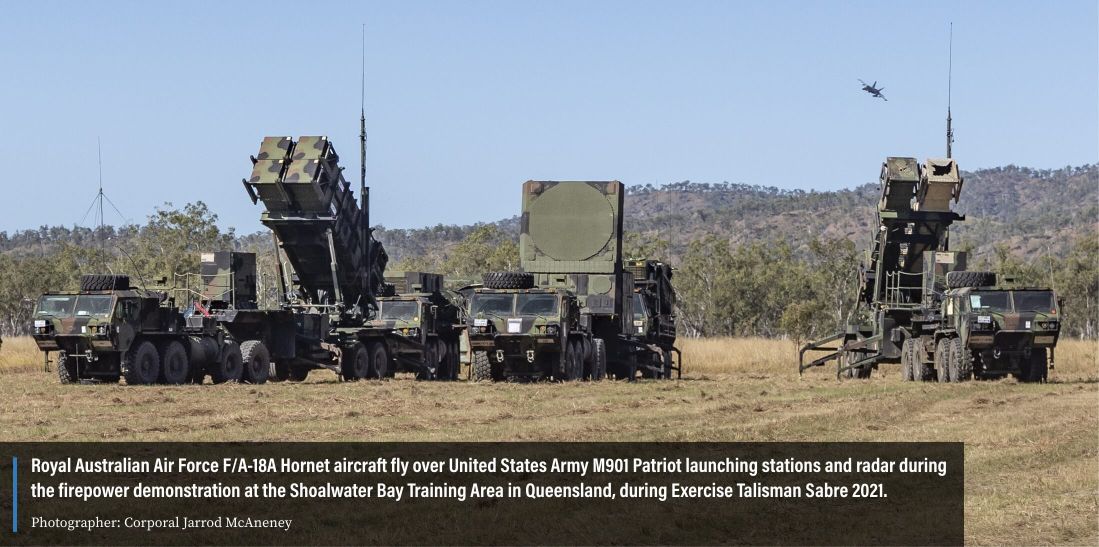
IAMD offers a concrete vehicle: common command-and-control standards, joint training on Agile Combat Employment concepts, and pre-positioned munitions kits. The United Kingdom’s 2025 Strategic Defence Review has highlighted air defence as essential for a “force fit for war in the 21st century”; Australia’s expanding GBAD regiments (potentially bolstered by Army Reserve integration) and the US Patriot system (combat proven and recommended for rapid acquisition) could form the nucleus of a trilateral layered system.
Protecting Submarine Rotational Force - West at HMAS Stirling and northern airfields would directly support Pillar 1 operations.
IAMD isn’t without its challenges
We must, however, remain clear eyed – challenges exist.
Classification barriers, intellectual property sensitivities and differing national acquisition timelines must be managed – but the ITAR exemptions already negotiated for AUKUS provide a foundation. Cost is another: high-end systems like Patriot or Terminal High Altitude Area Defense are expensive.
Yet the alternative, leaving northern Australia exposed while pouring resources into offensive long-range strike alone, is not only strategically incoherent, it is negligent.
As the USSC report on accelerating GBAD has argued in October 2025: “IAMD is a critical part of effective deterrence and essential for the Australian Defence Force to carry out a military strategy of denial.”
The timing is perfect. The 2026 NDS and IIP update offer Canberra the chance to reprioritise. AUKUS Defence Ministers’ meetings have already referenced “strengthened multi-domain integrated air and missile defence capability” as an area of progress.
Explicitly designating IAMD as a Pillar 2 workstream, perhaps through a new trilateral IAMD integration cell would signal seriousness and unlock accelerated funding, industry partnerships and allied burden-sharing.
The pay-off would be profound.
For Australia, a credible homeland shield would free air and naval assets for offensive operations deeper into the theatre.
For the United Kingdom, enhanced interoperability would amplify its Indo-Pacific tilt. Meanwhile, for the United States, protected forward bases in Australia would multiply its own deterrence posture without baring the immense costs of the sole responsibility for defence.
Collectively, AUKUS would demonstrate that its advanced capabilities pillar can deliver not just research papers but operational systems that deter conflict.
In the words of the CSIS analysis, narrowing Pillar 2 to autonomy, long-range strike and IAMD would “demonstrate AUKUS Pillar II’s viability and effectiveness, and more importantly contribute to the capabilities and lethality of warfighters”.
The window is however narrowing.
China’s missile forces are not waiting for perfect solutions. With political will at the 2026 planning cycle, AUKUS can turn IAMD from a capability gap into a trilateral strength, a shield that makes aggression unthinkable and underpins a free and open Indo-Pacific for decades to come.