

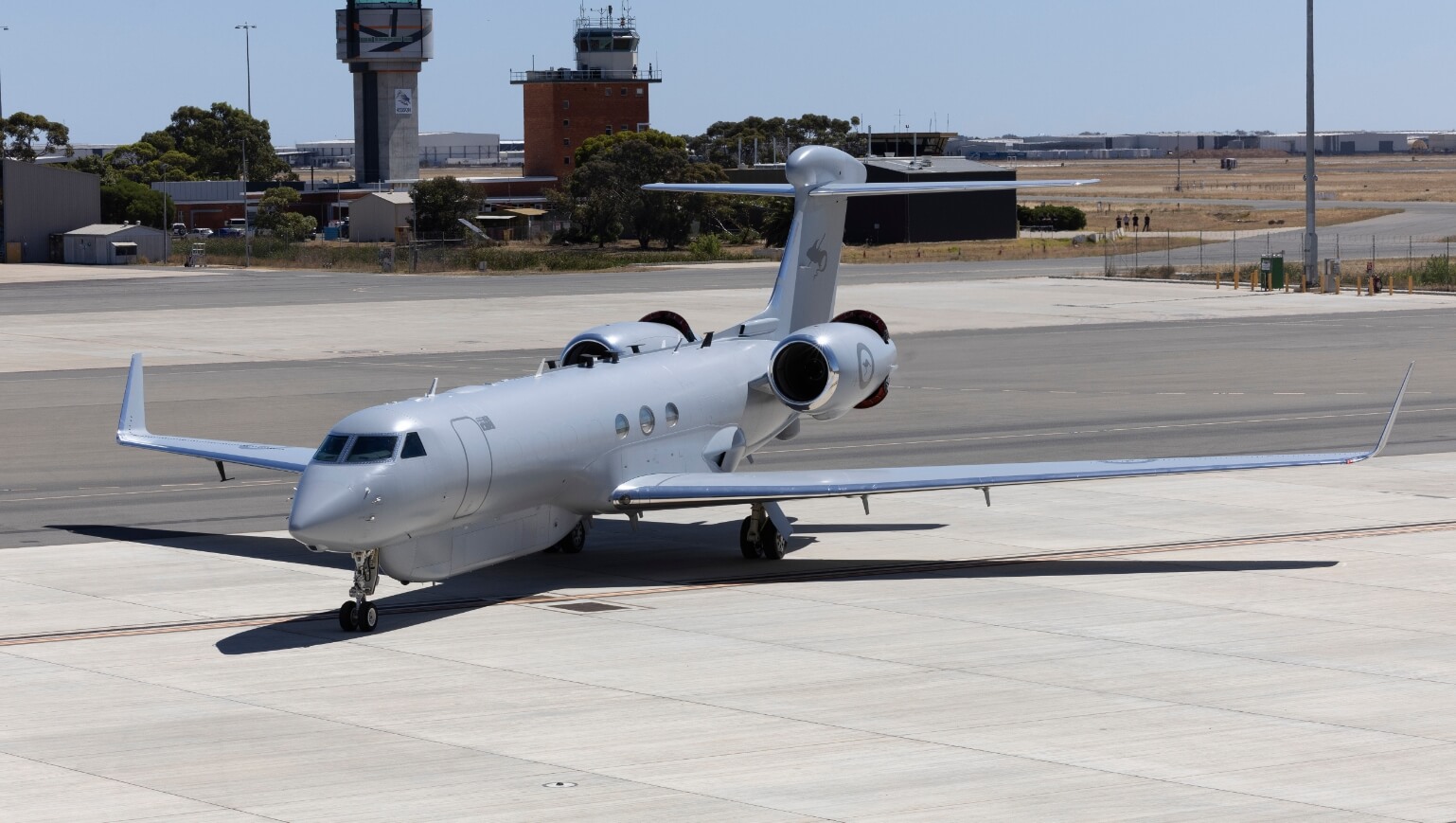
The first of four MC-55A aircraft has arrived at RAAF Base Edinburgh, South Australia, earlier this year, with the shiny new platform expected to act as a crucial airborne intelligence, surveillance, reconnaissance (ISR) and electronic warfare asset for the Royal Australian Air Force.
Modelled on the Gulfstream G550 airframe and extensively enhanced by L3Harris Technologies, the MC-55A long-range, surveillance and reconnaissance aircraft is designed to deliver multiple sources of intelligence in support of Defence operations.
Operated by No. 10 Squadron, the MC-55A Peregrine will be based at RAAF Base Edinburgh, South Australia.
This advanced capability reinforces Australia’s national defence posture and contributes to deterrence. Integrated within a focused and agile force, the MC-55A ensures the Royal Australian Air Force is ready to detect, disrupt, deter and, if necessary, defeat threats.
L3Harris Technologies Australia and New Zealand vice president Alan Clements has highlighted the important capability milestone of the aircraft during an exclusive interview with Defence Connect and its sister brand Australian Aviation on 24 February.
The former F/A-18 Classic Hornet instructor, commanding officer of No. 77 Squadron and Australian Defence attaché to the United States said it will be crucial in controlling and coordinating information relating to the electromagnetic spectrum.
“In my view, the electromagnetic spectrum is the high ground of the 21st century. If you don’t control the electronic spectrum, you don’t control the decision making,” he says.
“Whether that be through your communications, your data, your intelligence, surveillance, reconnaissance through cyber, all those areas. And decision making is what actually wins us the war in the end.
“This kind of advantage can allow limited forces in the right space at the right time to get the effect that you absolutely need.
“The MC-55 is critical to providing that information for those decision makers to be able to make the decisions at the right time … It’s bringing to the fight the ability to listen and categorise a lot of the electromagnetic spectrum at what we would class as a force-level space.
“There are other capabilities that are really important as well, like the EA-18G Growler electronic warfare aircraft (and -7A Wedgetail airborne early warning and control aircraft). There is also space-based electronic warfare, there’s EW that you’re seeing on ships for self-protection.
“All of those capabilities I think are critical to the Australian Defence Force to be able to execute under the national defence strategy that we’ve got … There’s advances that we should be thinking about as well is things like electronic attack.
“Even the context of national security, the ability to protect our communications networks, whether they’re underwater cables, satellite communications, are critical to national security of the nation. So I don’t think I can overstate the importance of the electromagnetic spectrum.”
The introduction of the MC-55A Peregrine is expected to strengthen Australia’s ability to monitor and protect its strategic interests, including over key maritime approaches.
The MC-55A Peregrine is more than an aircraft; it is a strategic capability that reinforces our ability to protect national interests in an increasingly complex security environment.”
- Chief of Air Force Air Marshal Stephen Chappell
The MC-55A is envisioned to be a key component of Australia’s broader ISR enterprise, complementing platforms such as the P-8A Poseidon and MQ-4C Triton, and forming a critical link in the nation’s sovereign network of surveillance and electronic warfare assets.
The first aircraft has been delivered by the US Air Force to the RAAF, and follow-on aircraft will remain in the United States Air Force’s possession while supporting RAAF training and pre-delivery requirements.
L3Harris has established a field service team in Australia to work alongside local industry partners for in-country support.
“The introduction of the MC-55A to Air Force’s fleet will ensure we have a critical enabler for advanced ADF capabilities and, as identified in the 2024 Integrated Investment Program, provide important intelligence information to support ADF missions,” Chief of Air Force Air Marshal Stephen Chappell says.
“The MC-55A Peregrine is more than an aircraft; it is a strategic capability that reinforces our ability to protect national interests in an increasingly complex security environment.”
Ongoing software and hardware upgrades are expected to help ensure the Peregrine stays ready to meet evolving threats and future mission needs for Australian security strategy.
Part of that upgrade evolution path will undoubtedly involve the integration of artificial intelligence platforms for rapid analysis to achieve faster response times, according to Clements.
“If we look at the lessons that have come out of many of the conflicts that are going around the world right now, that ability to upgrade and move quickly with what’s happening inside the area of operations is really important,” he says.
“Artificial intelligence is going to bring us pace of analysis … We’re seeing things out of other conflicts around the world that we can’t take two months or six months to take information, process it, turn around and then push back out some sort of counter to what we might have seen.
“In Europe at the moment we’re seeing turnarounds that have to be (made) in the days and, in some cases, hours to be able to counter what’s actually happening. And I think that’s only going to get less and less.
“Artificial intelligence is going to be critical in the analysis phase. Then the use of the AI to be able to generate a counter or another sensor or something that then turns around very quickly to go out and encounter what we’ve seen in airspace. That’s where it’s also going to be really, really important going forward.
“The artificial intelligence piece is absolutely critical to future speed of relevance.”