

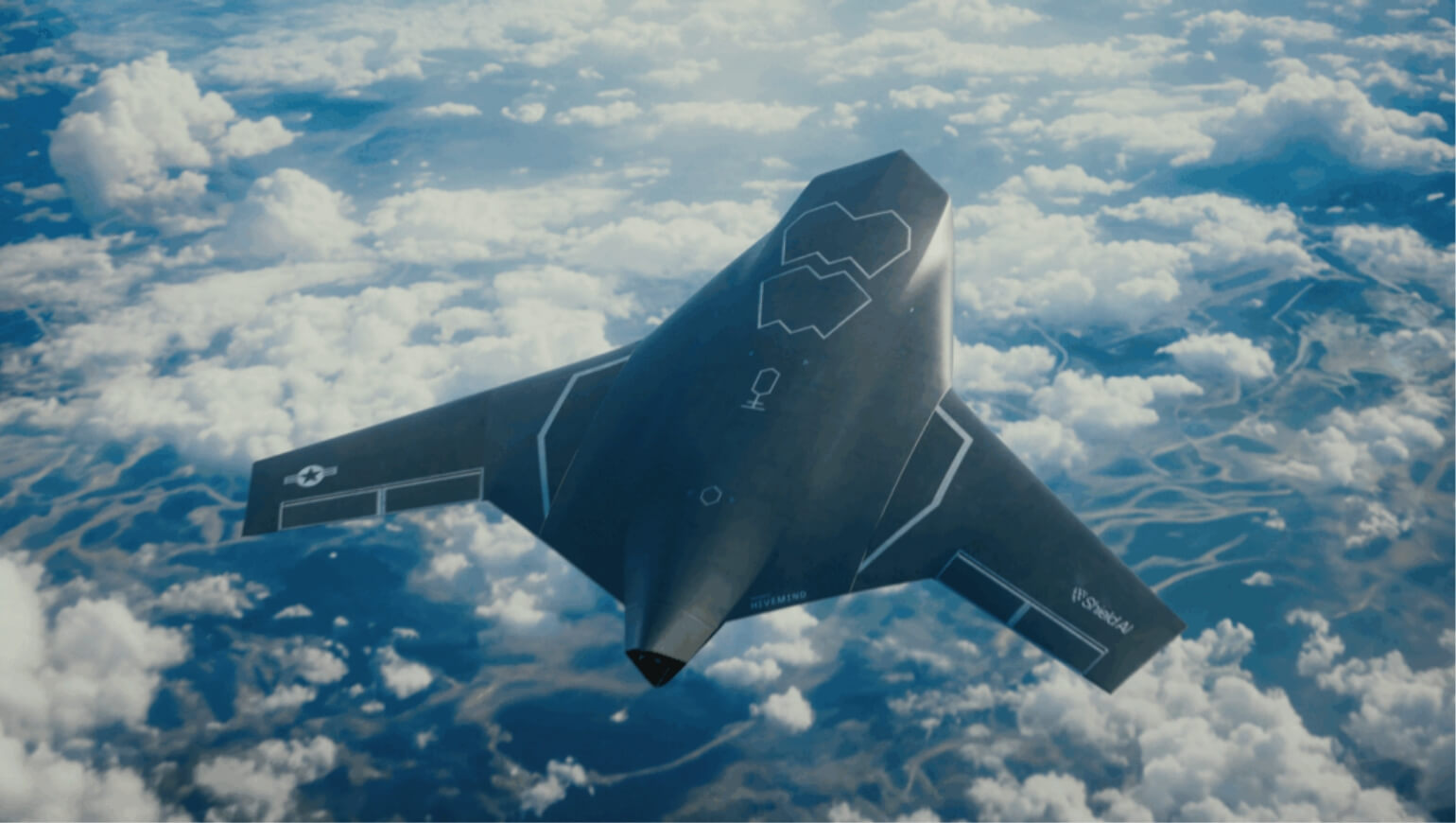
The company, known for its Hivemind AI flight software and the smaller V-BAT surveillance drone, describes X-BAT as an AI-piloted, runway-independent fighter. It is said to be able to launch and land vertically from trailers or austere sites, then climb to high altitude and dash at supersonic speed with a full mission load.
In short, Shield AI is pitching X-BAT as a “transformative” fourth-generation class jet that combines vertical take-off and landing (VTOL) agility, very long range (>2,000 nm), multi-role payloads and rugged autonomous operation.
Origins and development
Shield AI itself is a deep-tech start-up founded in 2015 by former US Navy special forces and Silicon Valley engineers. The company built its reputation on advanced autonomy software (Hivemind) and on Group-3 drones like the V-BAT, which have even seen combat use.
It has raised huge sums to fund growth. By late 2025, the firm’s funding round had pushed its valuation to over US$5 billion ($7.01 billion), with more than $1.4 billion ($1.96 billion) in equity and additional debt raised to date.
Notable investors include L3Harris, Andreessen Horowitz and others, while behind the scenes, Shield AI has been assembling a world-class team (even poaching talent from SpaceX) to tackle X-BAT’s challenges.
Locally, Shield AI’s Australian footprint is growing too. In 2024 it announced the acquisition of Sydney-based Sentient Vision Systems (an AI-enabled intelligence, surveillance and reconnaissance specialist) to create a local subsidiary.
That deal and the earlier joint development of a wide-area-motion infrared sensor (“Sentient Observer”) with Sentinel underline Shield AI’s commitment to the Indo-Pacific. In early 2025, its V-BAT drones achieved certification for Australian civil airspace and entered training programs, working with local partners like Toll Aviation.
All this suggests Shield AI sees Australia as a strategic ally for testing and employing its drones. X-BAT itself was first teased at the 2024 Paris Air Show and formally revealed in Washington DC in October 2025. Company leaders have displayed scale models and concept art – including tail-sitting mock-ups on launch trailers and highlighted Silicon Valley-esque aggressive timelines.
By their account, X-BAT has been under development for only 18 months when unveiled. High-speed ground testing (engines, aerodynamics, radar signature, thermal etc) has been underway, and Shield AI’s roadmap targets an initial VTOL demonstrator flight in late 2026 with an all-up flight test program in 2028.
In line with their Silicon Valley roots, the company aims for early production by about 2029, aligning with United States Air Force future programs. Key partnerships are also forming. In late 2025, Shield AI has announced a collaboration with GE Aerospace to adapt the proven F110 fighter engine (from F-15/F-16 jets) to power X-BAT and its 3D thrust-vectoring nozzle. Shield AI has hinted that additional partners (for airframe production, avionics etc) are coming.
From its inception, X-BAT has been pushed as a complete system solution – not just an airframe. The aircraft is being designed from the start around autonomy and flexibility. Company officials emphasise that nothing in X-BAT’s design is left to chance: all major risks (VTOL control, stealth shaping, engines, sensors) use mature, flight-proven technologies.
For example, X-BAT’s tail-sitter VTOL architecture avoids complex lift fans or tiltrotors, instead it uses a single F100/F110 class turbojet with afterburner, aligned with the fuselage, to achieve vertical launch. Because many high-performance fighters already have thrust-to-weight >1, the afterburning F100/F110 provides enough push to lift the jet straight up.
A 3-axis thrust-vectoring nozzle (an updated version of 1990s “ACTIVE” technology) will then tilt the exhaust to balance and control the aircraft during hover and transition. In short, no additional booster is needed – X-BAT “lifts off like a rocket” under full reheat, then pitches nose-down at about 1,600 feet to fly in wingborne mode before continuing to climb to its operational altitude.
Landing is essentially the reverse process. Early X-BAT promotional videos show the jet (now nearly empty of fuel) flaring into a vertical descent onto a trailer cradle – a capability evoking the 1950s Bell X-13 tail-sitter experiments. Shield AI has reportedly leveraged its experience from V-BAT and modern guidance/control systems to make this automated landing feasible (a key advantage is that the system uses throttle control for stability instead of an arrested hook).
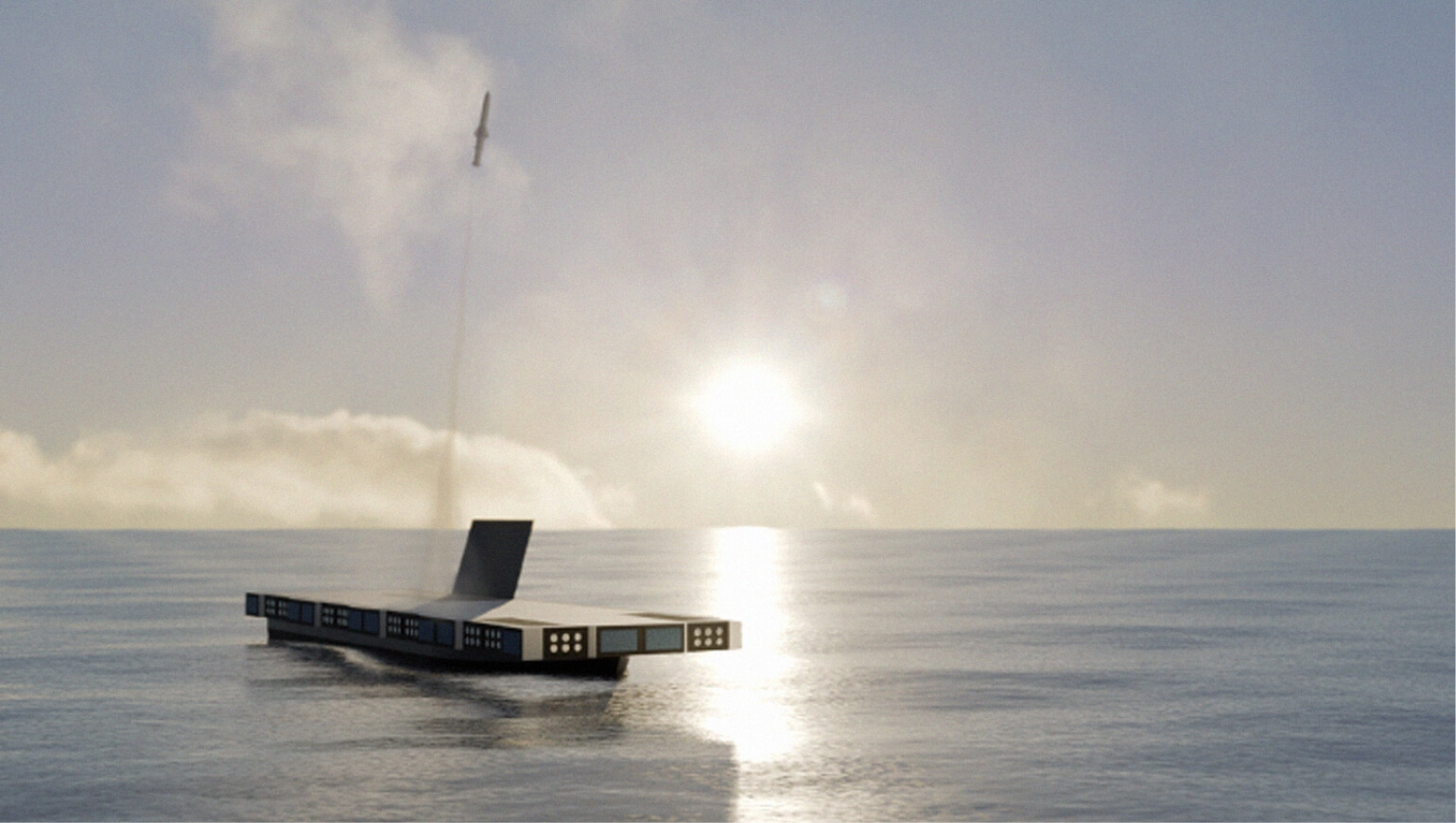
The company plans multiple trailer-launch and -recovery units per aircraft, meaning an X-BAT unit could operate from any prepared site at relatively short notice. This runway-free lift-off and landing mode is central to X-BAT’s strategic promise – it lets jets “go to where the fight is” even if runways are contested or cratered, effectively extending the reach and survivability of airpower.
Incorporating proven tech to mature at pace
At roughly 26 feet long with a 39-foot wingspan, the X-BAT is about the size of a classic light fighter (comparable to an F-5). Its shape is a flying-wing/cranked-delta planform with smooth control surfaces and no vertical tail – optimised for stealth against radar. Shield AI calls it a “fourth-generation” design and indeed, it resembles a sleek, engine-down the middle, faceted wing. The powerplant (GE F110-GE-129) and vectoring nozzle are proven hardware, while the rest of the airframe uses advanced composites and shaping to reduce infrared and radar signatures.
Performance goals are ambitious. Shield AI says X-BAT will exceed Mach 1.2 (i.e. supersonic cruise), enabling it to keep pace with modern fighters. Combined with its high thrust-to-weight ratio, this will allow rapid insertion or egress from combat zones. Its reported service ceiling is >50,000 feet. Most striking is its range – the company claims over 2,000 nautical miles (3,700 kilometres) on internal fuel with a combat payload. At that range, X-BAT’s combat radius could approach 1,000 nm (1,850km), far beyond typical uncrewed aerial vehicles.
This extraordinary endurance – only possible by combining jet performance with large fuel capacity – is said to allow theatre-scale operations (e.g. Pacific islands), critically without tanker support. Even with external stores, Shield AI suggests one X-BAT’s range exceeds that of many fighters; for example, its 2,000 nm range is roughly equal to that advertised for Australia’s Ghost Bat loyal wingman drone (which is subsonic).
Internally, X-BAT is designed to be multi-role. It will include a weapons bay (for air-to-air and air-to-ground munitions) plus four external hardpoints for missiles or bombs. Shield AI’s promotional material shows it carrying standard Western missiles: AIM-120 Advanced Medium-Range Air-to-Air Missiles and even the new AIM-174B “Gunslinger” very-long-range A2A missile for Navy use.
Concept art shows it able to deploy a wide variety of small precision weapons. The bay and pylons could also house electronic warfare pods, datalinks or extra fuel tanks as needed.
In practice, X-BAT might carry a mix of air-to-air missiles (for escort or counter-air), bombs or stand-off weapons (for strike), and sensors (radar, electro-optical/infrared, radar warning receiver/electronic warfare suites) for intelligence, surveillance and reconnaissance (ISR) or jammer roles. The airframe is intentionally modular – payload units can be swapped for different missions.
Crucially, X-BAT will operate autonomously under Shield AI’s Hivemind software. This AI system is built to cope with jammed or GPS-denied conditions and to fly complex formations and tactics with minimal human input. In practice, a human “mission commander” could task a group of X-BATs with objectives (e.g. “find and escort friendly jets to this waypoint”) and the drones would carry out flights, target identification, threat engagement or cover suppression on their own. They can also pair up with a crewed fighter: the fighter acts as a commander/sensor node, delegating tasks to the drone(s) (the so-called “loyal wingman” role).
Because Hivemind has evolved from manned-fighter autonomy (even reportedly flying F-16s and MQ-20 Avenger drones during testing), X-BAT’s software is expected to meet high combat standards. The AI also allows flexibility of command – if communications with the mothership drop out, X-BAT continues its mission with built-in contingencies.
A new era for manned-unmanned teaming in Indo-Pacific air combat doctrine
The X-BAT is explicitly conceived for manned-unmanned teaming and “loyal wingman” operations. In US military doctrine, a loyal wingman is an uncrewed aircraft that accompanies manned fighters into combat, multiplying sensor reach and firepower while taking on high-risk tasks. The Royal Australian Air Force, for example, is already building the Boeing MQ-28A Ghost Bat as a loyal wingman for its F-35A fleet.
Shield AI pitches X-BAT as the next step in that concept – a high-end wingman that can accompany F-35s or future Next Generation Air Dominance-type fighters on deep missions.
In practice, an F-35 or F-22 pilot might direct X-BAT(s) via datalink to perform screen, scout or suppress missions. For instance, X-BAT could fly ahead or on the flanks of a strike package, using its stealth and AI to locate and engage threats. It could loiter to provide long-range targeting or ECM support.
With its long range, X-BAT could also act independently as a “gunship” from a distant base or carrier, returning after its mission. When operated as a swarm or team, multiple X-BATs can coordinate their actions with or without continuous human oversight.
This fits wider trends. The USAF and Navy have active Collaborative Combat Aircraft (CCA) programs exploring similar concepts, having already chosen demonstrators (e.g. Anduril and GA for Increment 1) and now eyeing more advanced wingman designs. Shield AI plans to compete in CCA Increment 2 with X-BAT. Likewise, Australia, the UK, and other allies are researching CCAs and loyal wingmen. Indeed, an Air & Space Forces report notes “other countries like Australia, the Netherlands, and the United Kingdom are also exploring” this class of drone.
Australia’s own Ghost Bat is a smaller, subsonic CCA, mainly for sensor escort roles, whereas X-BAT would be a more lethal, supersonic counterpart – potentially of interest to AUKUS partners if proven.
Beyond two-ship teaming, X-BAT points towards future swarm warfare. If hundreds of affordable X-BATs could be produced, they might saturate enemy defences or conduct massed strikes under AI control. Shield AI’s CEO frames this as “airpower without runways” – projecting deterrent mass from many dispersed points.
In a contested Pacific scenario, for example, X-BATs could be dispersed among island outposts or amphibious ships. Losing some to enemy fire would be acceptable if tens remain to accomplish the mission – a departure from risking a single $100+ million crewed jet.
This attritable strategy is a key selling point: the company markets X-BAT as delivering “fighter-class performance at an order of magnitude lower” cost and risk. In contrast, fifth-gen fighters and their missiles cost millions per hour or shot, so having a layer of cheap, smart drones can multiply force size at modest expense.
Reshaping the strategic calculus
The rise of aircraft like X-BAT could reshape air force structure and operations. Survivability on the modern battlefield increasingly means avoiding static runways and chokepoints. X-BAT’s VTOL capability directly addresses this by allowing operations from remote or quickly constructed sites.
The rise of aircraft like X-BAT could reshape air force structure and operations. Survivability on the modern battlefield increasingly means avoiding static runways and chokepoints.”
It has been noted that a VTOL jet that can hide in forests or caves is much harder for an adversary to neutralise on the ground than a conventional jet on a runway. This aligns with the US concept of Agile Combat Employment, which envisages small units of fighters and support assets operating from dispersed, austere locations to complicate enemy targeting. Three X-BATs can even pack into the deck space of one traditional fighter aircraft on transport, tripling sortie rate from a given runway.
For pilot safety, X-BAT’s fully autonomous mode means human crews stay further from high-threat zones. A human pilot can direct X-BAT to fly point or hunt surface threats, letting the drone face first-pass risks. In the event of heavy enemy air defences or anti-access zones, manned fighters could lurk at stand-off while X-BATs press the engagement.
Thus X-BAT extends the reach of fifth-gen jets without exposing airmen to initial waves of fire.
On force structure, adding attritable wingmen could reduce the number of highly expensive jets needed for certain tasks. A mix of F-35s (or future sixth-generation NGAD) and X-BATs could cover a mission set that once demanded a larger fleet of crewed fighters. The idea is analogous to having “cheap chaff” to distract Surface-to-Air Missiles while the core of the strike package passes.
The RAAF’s own roadmap is already moving this way: the MQ-28 Ghost Bat (a Boeing-developed CCA) is being acquired to team with F-35s for ISR and escort. X-BAT, while not an Australian program, complements that vision by adding a higher-speed, longer-endurance option. In joint US–Australia exercises or AUKUS integrated force concepts, having interoperable CCAs could allow shared tactics, for example, a US F-35 controlling a US X-BAT and an Australian Ghost Bat in concert.
Finally, on cost-efficiency, Shield AI asserts that X-BAT will be much cheaper to buy and operate than legacy fighters. A recent estimate has given a target unit cost of about $27 million, roughly the Air Force’s original budget for a CCA. By contrast, an F-35A costs about $80–100 million per aircraft, with $100,000+ daily sortie costs.
Even big missiles like the AIM-120 or AIM-9 cost on the order of $1–2 million. By building X-BATs with commercial practices (rapid digital design, smaller teams, concurrent testing), Shield AI hopes to drive that cost down. (Indeed, The War Zone comments note that by leveraging modern CAD and AI tools, they are building X-BAT with far fewer engineers than Cold War jets required.)
The attritable model still has costs, its jet engine alone is in the million-dollar range, but the idea is to accept losses rather than ensure every aircraft survives at any cost.
Eyes on the future
Despite the hype, experts caution that X-BAT is extremely ambitious. As one analyst put it: “What Shield AI is attempting to pull off … is no small task and there will certainly be sceptics along the way.” Converting a jet fighter into a reliable VTOL drone involves serious aerothermal and control challenges.
The stealth-shaping, weapons integration, autonomous tactics and hardened comms are all complex to get right. Even if the individual technologies exist, integrating them on a tight schedule is risky.
So far, Shield AI has mitigated the risk by extensive early testing (wind tunnel, model radar cross section, engine runs) and by using off-the-shelf components where possible. Its team’s pedigree (SpaceX veterans in launch tech, ex-military engineers) also gives confidence.
Another unknown is cost and sustainment. Shield AI claims affordability, but real-world production often reveals hidden costs (engine maintenance, complex GNC gear, high-end sensors/missiles). The RAAF’s analysis of its own Ghost Bat program emphasises that sensors and missiles remain expensive “even for attritable drones”.
If X-BAT uses large jets and high-end armament, its attritability threshold may be higher than anticipated. On the other hand, Shield’s use of a common fighter engine (with existing logistics chains) and modular payloads should help keep maintenance more routine than a totally new design.
Critics also note that autonomous aircraft raise ethical and command-control issues, though both US and Australian doctrines currently restrict lethality decisions to humans, so X-BAT would operate under supervision.
Finally, there is a timing challenge. Shield AI’s schedule (first flight ~2026, production by 2029) is very aggressive for a new combat aircraft, even a drone. To succeed, the company will need substantial engineering and funding to meet milestones.
Its recent fundraising and acquisition moves suggest it has resources, but it will face competition for Air Force dollars and attention (especially if the USAF does not finalise CCA requirements soon).
On the other hand, the Pentagon’s urgent drive to field CCAs and allied pressure to counter peer threats (e.g. in the Indo-Pacific) provide strong incentives to push programs like X-BAT forward.
In conclusion, Shield AI’s X-BAT represents a bold vision of future air combat: stealthy, supersonic, AI-driven jets that need no airfields.
If realised, it could significantly enhance joint US–Australian airpower by expanding the “manned-unmanned” battlefield.
For Australia, even partial adoption of X-BAT concepts would dovetail with its MQ-28 Ghost Bat and F-35 fleets to create a layered network of crewed and uncrewed platforms. For the US, X-BAT and similar drones will complement the F-35 and future NGAD fighters, allowing a more flexible, dispersed force posture.
Time and further testing will tell if Shield AI can deliver on this promise, but for now, X-BAT has certainly put the US–Australia alliance’s skies on notice that the age of AI wingmen is near.