

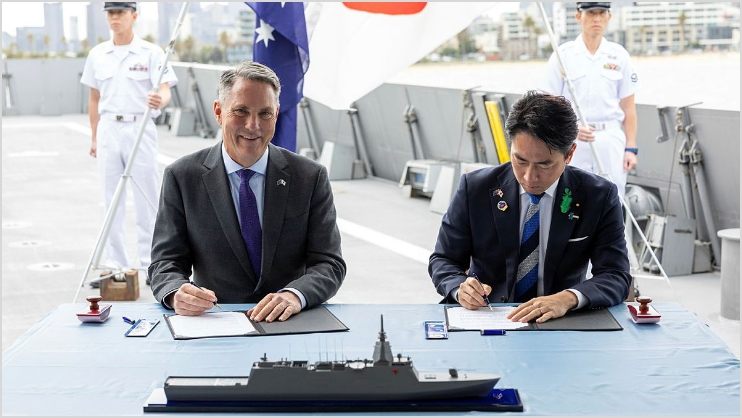
On 18 April 2026, Deputy Prime Minister and Defence Minister Richard Marles and his Japanese counterpart, Minister of Defense Shinjirō Koizumi, formalised the acquisition of the first of 11 evolved Mogami Class general purpose frigates under the $20 billion SEA 3000 program, a milestone that Defence Industry Minister Pat Conroy described as “the fastest acquisition for the Royal Australian Navy in peacetime”.
But for those watching Australia’s naval trajectory carefully, the frigate deal is not merely a capability acquisition. It is the opening move in a far larger strategic chess match, one that points inexorably towards the question of what comes after the Hobart Class destroyers.
Taken together, the Mogami partnership, now cemented in law and bilateral memoranda, has created the industrial, diplomatic and strategic architecture needed to begin serious planning for a Hobart Class replacement.
A strategy built for a dangerous decade
The 2026 National Defence Strategy (NDS) makes no attempt to soften its assessment of Australia’s strategic environment. Building on the foundations laid by the 2023 Defence Strategic Review and the inaugural 2024 NDS, it identifies the Indo-Pacific as a theatre of accelerating contest, drawing explicitly on lessons from the wars in Ukraine and the Middle East to sharpen capability priorities.
At its core, the strategy doubles down on the concept of National Defence and the Strategy of Denial, the idea that Australia must be able to hold potential adversaries at risk from distance, reducing their capacity and will to project force against Australian or allied interests.
To fund this ambition, the government has committed an extraordinary $425 billion over the decade to 2035–36, including an additional $53 billion beyond the 2024 Integrated Investment Program (IIP) baseline. Defence spending is projected to reach 3 per cent of gross domestic product by 2033 under the NATO measurement approach, a figure that would have seemed politically inconceivable just a decade ago.
Within that envelope, the Navy has emerged as the pre-eminent beneficiary, with between $94 and $130 billion allocated to undersea warfare and a further $52 to $65 billion directed at expanding and lethally enhancing the surface combatant fleet.
It is against this backdrop that both the frigate contract and the emerging argument for an accelerated Hobart Class replacement must be understood. The 2026 IIP explicitly prioritises accelerating the delivery of more lethal maritime capabilities, expanding long-range strike and integrating air and missile defence, precisely the capabilities that a modern surface combatant fleet must embody. The Mogami Class frigates are one pillar of that fleet.
But they are a general-purpose platform, not an air warfare destroyer. The strategic gap they are designed to fill is different and arguably less demanding than the one that will open as the three Hobart Class destroyers age into the 2030s and beyond.
The Mogami deal: More than a frigate purchase
The contract signed in Tokyo represents a genuine landmark moment in Australian naval history.
The first three vessels are to be constructed by Mitsubishi Heavy Industries in Japan, with the initial ship expected to enter Royal Australian Navy service by 2029. Subsequent hulls are slated for construction at the Henderson Defence Precinct in Western Australia, a transition that underpins the government’s broader “Future Made in Australia” agenda and is expected to sustain around 10,000 high-skilled jobs over two decades.
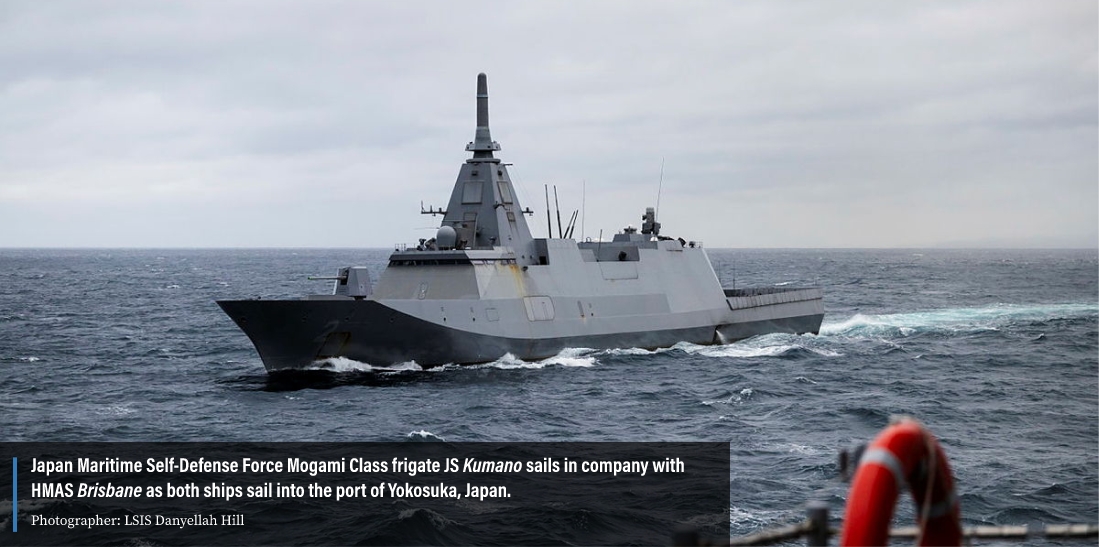
The platform itself is formidable for its class. The upgraded Mogami Class design offers a range of up to 10,000 nautical miles, a 32-cell vertical launch system capable of housing surface-to-air and anti-ship missiles, accommodation for a core crew of 92, and compatibility with the RAN’s MH-60R Seahawk helicopter fleet.
Combined with the “Mogami Memorandum”, the bilateral agreement reinforcing defence industry cooperation between Canberra and Tokyo, the deal represents a structural deepening of the Australia–Japan security relationship that extends well beyond the exchange of hardware.
Crucially, Royal Australian Navy personnel have already been training aboard the Mogami Class frigate JS Kumano during its deployment to Australia for Exercise Kakadu, a fact that speaks to the operational interoperability being deliberately cultivated between the two navies.
This is not simply a transactional arms purchase; it is the deliberate construction of a shared industrial and operational ecosystem, one that the 2026 NDS explicitly endorses through its emphasis on building stronger and more diverse international industrial partnerships.
This is not simply a transactional arms purchase; it is the deliberate construction of a shared industrial and operational ecosystem, one that the 2026 NDS explicitly endorses through its emphasis on building stronger and more diverse international industrial partnerships.”
The strategic ceiling: What the Mogami Class cannot do
However, there are very real limitations on what the Mogami Class and, indeed, the other surface combatants of the proposed Royal Australian Navy’s surface fleet can do.
The 11 general purpose frigates, alongside the six Hunter Class anti-submarine frigates and the three upgraded Hobart Class destroyers, will form the backbone of Australia’s surface combatant force through the 2030s.
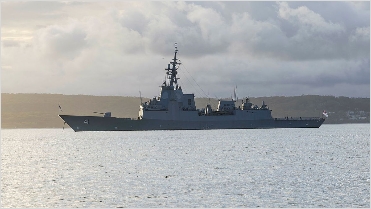
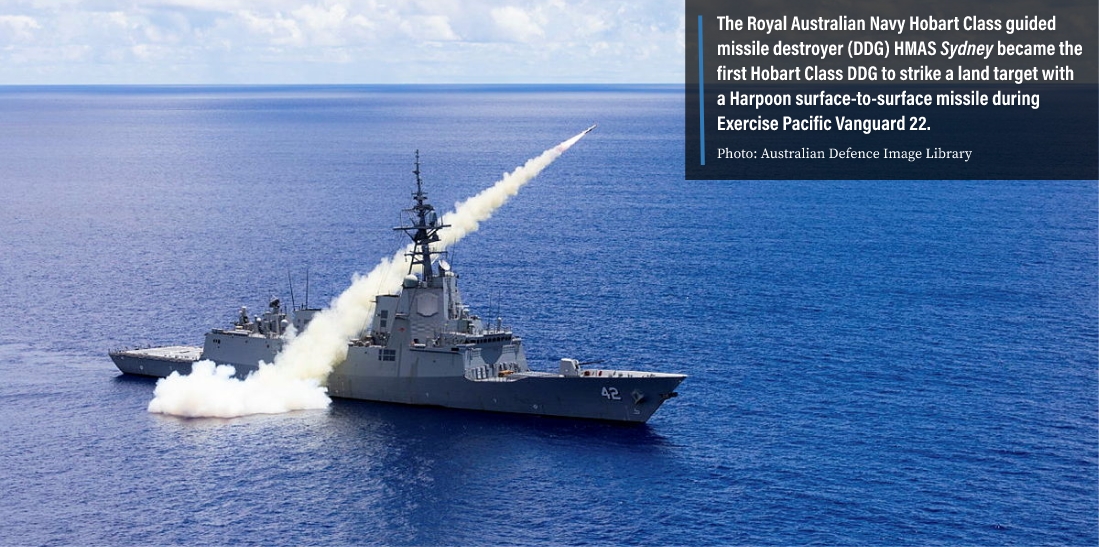
But the Hobart Class, for all its capability, carries significant limitations in the context of the threat environment the 2026 NDS so candidly describes.
Three ships, however capable, cannot provide persistent air and missile defence across Australia’s vast maritime domain. Each Hobart ship carries only 48 vertical launch cells, a figure that constrains the layered missile defence and long-range strike options increasingly demanded by the Strategy of Denial.
The 2024 Surface Combatant Fleet Review acknowledged this by committing to Tomahawk cruise missile integration on the Hobart Class, extending their relevance into the 2030s.
But mid-life upgrades, however valuable, are not a permanent answer to the structural challenge of operating a high-end warship in an increasingly contested maritime environment against adversaries fielding ever more capable anti-ship and ballistic missile systems.
The 2026 NDS’ emphasis on integrated air and missile defence is, in this context, a statement of strategic necessity rather than aspiration.
China’s Type 055 Renhai Class guided missile cruisers, displacing over 12,000 tonnes and carrying 112 vertical launch cells, have fundamentally altered the calculus of surface warfare in the Indo-Pacific. Australia’s response to that challenge cannot rest entirely on three destroyers that entered service between 2017 and 2020.
An ASEV-A: The logical next step
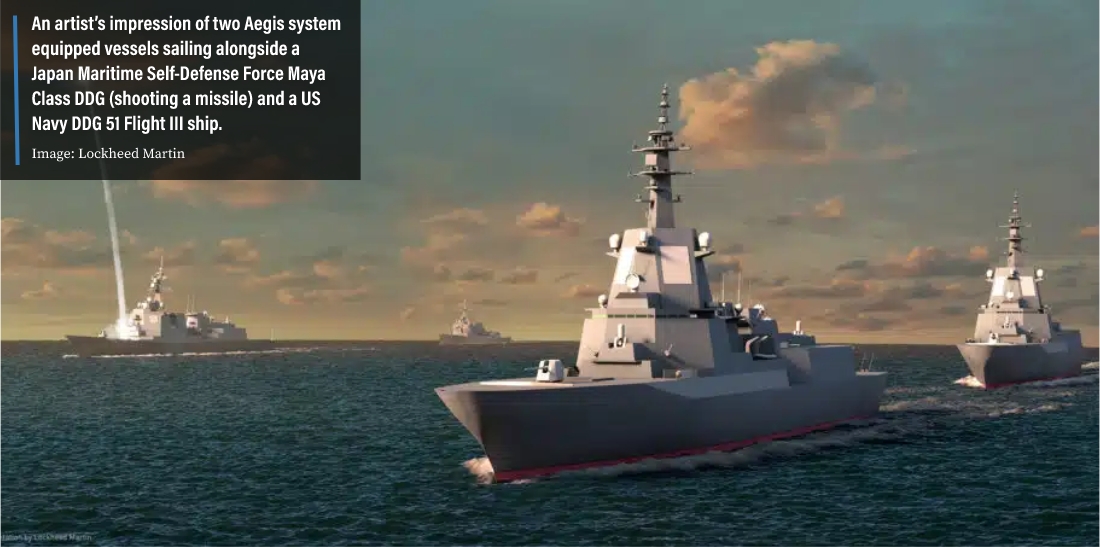
Japan’s in-development Aegis System Equipped Vessel (ASEV) – a 12,000-tonne-plus destroyer stretching 190 metres, armed with 128 vertical launch cells and equipped with the AN/SPY-7 AESA radar – is precisely the class of vessel that Australia will need to replace the Hobart Class with when they reach the end of their service lives in the late 2030s.
The strategic logic is compelling on multiple levels. The shared Aegis architecture that underpins both the Hobart Class and the ASEV would ensure seamless interoperability with Japanese and American forces, a central objective of the 2026 NDS’ vision for networked deterrence. Common missile inventories, including SM-3, SM-6 and Tomahawk, would further align Australian force structure with allied capabilities.
The ASEV program is already well advanced in Japan, reducing the technical risk and schedule uncertainty that plagued the Hobart program’s troubled construction phase.
Critically, the industrial pathway now exists. The Henderson Defence Precinct, which the 2026 IIP commits to developing as a genuine continuous naval shipbuilding hub will already be geared for the Mogami build.
The economies of scale, workforce development and supply chain investment that flow from 11 frigates worth of production create the precise conditions needed to transition, in due course, to a more complex destroyer build.
A notional “ASEV-A” variant, tailored to Australian requirements and built on the same Aegis foundation, would sit logically at the apex of a fleet architecture in which the Mogami Class frigates provide general purpose capability, the Hunter Class specialises in anti-submarine warfare, and the next-generation destroyer provides the air and missile defence envelope that the entire force structure depends upon.
Translating strategy into structure
The 2026 NDS and IIP are, at their best, a framework for sustained strategic discipline – the recognition that the capability choices made today will define Australia’s security options for a generation.
The government’s commitment to between $52 and $65 billion for the surface combatant fleet over the decade is substantial, but it is also a floor, not a ceiling. The 2026 IIP’s surface combatant numbers – 11 Mogami Class frigates, six Hunters, three upgraded Hobarts – describe a fleet architecture for the 2030s.They do not yet describe one for the 2040s.
Planning for the Hobart Class replacement does not need to begin with a signed contract tomorrow. It needs to begin with a deliberate conversation between Defence, industry and Australia’s Japanese partners about the kind of destroyer Australia will need when the Hobart Class finally leaves service.
The Mogami Class contract has done something profound: it has demonstrated that Australia and Japan can cooperate at the highest levels of naval industrial complexity, with bilateral political commitment, shared operational frameworks, and a genuine willingness to invest in each other’s security. That foundation is precisely what an ASEV-A program would require.
The 2026 NDS calls for greater self-reliance and stronger international partnerships in the same breath, not as a contradiction, but as a recognition that in the contemporary Indo-Pacific, the two are mutually reinforcing.
A fleet built around Australian-assembled Mogami Class frigates and a future Australian–Japanese destroyer represents exactly that synthesis: sovereign capability delivered through trusted alliance relationships.
The frigates are signed for. The destroyers are the next conversation Australia needs to be having.