

Despite being thousands of kilometres away, the war in Iran is continuing to be felt through economic uncertainty and renewed pressure on our national struggle with the cost of living.
The impact that this is having on global maritime security, Australia’s naval capacity, and exposure of national vulnerabilities is a complex, interconnected web of oil and ocean.
Why is this affecting Australia?
Geographically, Iran is one of the most strategically important countries in the world.
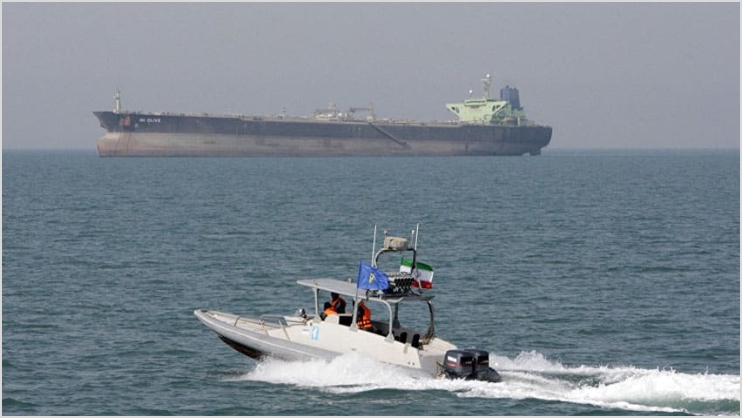
The Strait of Hormuz sits between the Persian Gulf and the Gulf of Oman and is the only shipping sea passage in the region.
It is responsible for exporting a quarter of the world’s oil every single day.
At just over 50 kilometres wide, the passage sees tankers carrying crude from major Gulf producers such as Saudi Arabia, Iraq, Kuwait and the United Arab Emirates to international markets.
Because so much of the world’s energy supply depends on this single passage, even the mere threat of disruption in the Strait of Hormuz can quickly send shockwaves through global markets and push oil prices higher – not to mention the fearmongering and panic buying that follows.
Obviously, more than the threat of disruption has occurred and the strait is practically inoperable as missiles and drone strikes continue to batter all countries that border the region, as well as direct attacks on oil fields and production sites.
From national addresses by the prime minister, talks of running on reserves, and on and off ceasefires, for the average Australian just wanting to fill up their car on the way to work, it is far from an ideal situation.
The Maritime Union of Australia (MUA) has called on the government to take stronger action, saying that this situation is the precise reason Australia needs to localise fuel storage and limit reliance on foreign supply.
“The closure of the Strait of Hormuz during the recent attacks on Iran is a stark warning of the volatility of Australia’s access to global fuel supply chains,” says Jake Field, MUA National Secretary.
“We mustn’t gamble our economic stability on uninterrupted access to foreign fuel markets.
“We cannot assume that geopolitical tensions will always resolve before our reserves run dry.”
As tensions involving Iran escalate, the focus has largely centred on fuel prices and supply shocks, but the deeper issue at hand is the disruption of global sea lines of communication and the growing vulnerability of maritime chokepoints that underpin Australia’s economic security.
As tensions involving Iran escalate, the focus has largely centred on fuel prices and supply shocks, but the deeper issue at hand is the disruption of global sea lines of communication and the growing vulnerability of maritime chokepoints that underpin Australia’s economic security.”
Maritime security
Virtually holding the world at their will, Iran has a major strategic role in the maritime security space.
Over the past week, Iran’s Joint Maritime Information Center has said that 18 ships would be able to transit through the strait; however, the Iranian Islamic Revolutionary Guard Corps Navy reportedly attacked civilian ships.
Days later, the United States fired at an Iranian cargo ship and is reportedly blocking Iranian ports, turning away over a dozen vessels.
So, the situation is fluid, uncertain and unknown, to say the least.
The Royal Australian Navy has long operated in the Middle East under frameworks that seek to contribute to maritime security and freedom of navigation operations.
However, Australia and other allied nations may be at a potential point of transition from presence missions and more into deterrence and countermeasure operations.
Experts are saying that this is a long needed wake-up call for Australia’s maritime policy.
“The crisis in the Strait of Hormuz should be understood not as a distant Middle East problem, but as a warning,” maritime security and naval expert Jennifer Parker wrote for The Australian Financial Review.
“In a serious conflict, Australia’s vulnerability will be defined less by threats to the continent than by our ability to protect the maritime lifelines on which the nation depends.
“Australia still lacks a coherent maritime strategy and the national structures needed to implement one. That is the issue we must now confront.”
Former naval captain and warfare officer Dr Sean Andrews, writing for the Lowy Institute, agrees: “Australia’s core vulnerability has never been invasion. It has been isolation.”
While all this is happening in the Middle East, Australia still has stability in the Indo-Pacific to worry about, and any sustained commitment to Middle Eastern maritime security risks drawing finite naval assets away from Australia’s primary strategic, regional concerns.
With suspected tension to rise in the Indo Pacific and South China Sea within the next decade, the sentiments from experts are bleak and, frankly, concerning, urging the powers that be to take definitive measures to ensure Australia’s maritime strategy is at the forefront.
“Australia’s vulnerability lies in the interaction between the two. A disruption at Hormuz constrains supply. Disruption across Indo-Pacific sea lanes constrains distribution. Together, they compound. This is not a hypothetical scenario, and it changes the strategy required,” Dr Andrews writes.
“Hormuz will remain critical. But it is only the beginning of the problem. The real test lies across the wider maritime system – open, expansive and deceptively resilient. A maritime nation must think accordingly.”
With the release of the National Defence Strategy, maritime spending has not seen much of a change in funding from two years ago, with most of the money being invested into AUKUS capabilities.
Essentially, experts want more action from the government, seeing Hormuz as the clearest indicator of how critical our maritime security is, not from an offensive standpoint, but from an access and availability position.