

Government and industry planning documents emphasise the scale: the Albanese government has earmarked $8 billion for HMAS Stirling upgrades and $12 billion for a new Henderson Defence Precinct, with an initial $3.9 billion down payment on a $30 billion nuclear-capable build hall at Osborne, South Australia.
Key priorities include deepening docks, building secure maintenance facilities and installing radiation‐safe systems. Australian and allied regulators (under the new Naval Nuclear Power Safety Act 2024 and existing Australian Radiation Protection and Nuclear Safety Act) will enforce stringent nuclear safety and non-proliferation standards.
Key opportunities include thousands of jobs and technology transfer across local supply chains, which will prove critical if Australia is to truly become “nuclear ready”.
However, this won’t be an easy task and won’t be delivered overnight, rather, challenges loom in workforce development, funding and environmental consent. Interoperability with United States and United Kingdom forces and contingency plans (e.g. alternate berths or support ships) also feature.
Termed “nuclear-ready” infrastructure, this encompasses piers, dry docks, high-integrity utilities, waste management facilities, security perimeters and associated operational workflows.
For a nation without prior domestic nuclear propulsion submarine experience, the endeavour presents a complex interplay of technical, regulatory, cultural and logistical demands. Drawing on expertise from Stantec, a firm with operations across the AUKUS partners, this analysis examines the principal opportunities and challenges in delivering this capability.
Nuclear readiness is fundamentally about radiation protection rather than weapons. Rob Sansbury, Stantec defence sector leader for Australia and New Zealand, clarifies that the focus is “to protect people from nuclear radiation” and explicitly not about “being prepared to deploy or use nuclear weapons, it’s not having warheads on standby”.
Stantec safety case consultant Chris Waywell, who has UK experience, outlines the three core components that reinforces that success ultimately rests on people:
• Organisation – having the right people with the right training and skills.
• The right physical infrastructure.
• Having the regulation, that sort of independent oversight.
“It’s the people that ultimately make the decisions on how to operate, on how to maintain and on how to keep everything safe,” says Robert Fogel, principal for defence ports at Stantec.
It’s the people that ultimately make the decisions on how to operate, on how to maintain and on how to keep everything safe.”
- Robert Fogel
We will face cultural and regulatory changes
The most significant barrier lies in cultivating a nuclear safety culture within Australia’s regulatory and societal context. The Australian Naval Nuclear Power Safety Regulator became operational on 1 November 2025, yet it must rapidly develop capacity while drawing on established US and UK frameworks.
Sansbury acknowledges Australia’s position as “the junior cousin in this relationship”, noting that Stantec’s unique tri-national footprint has enabled substantial knowledge transfer. Nevertheless, the absence of institutional memory means the regulator, workforce and broader defence community are building expertise from a low base.
Workforce development is ambitious: government estimates project a nuclear-ready cadre of approximately 20,000 personnel spanning operators, maintainers, regulators and support roles.
Early initiatives – Australian sailors training at US nuclear power schools, maintainers embedded in American shipyards and incremental “small ship availabilities” conducted domestically – signal progress, as Fogel observes.
“We’re starting with the easy stuff, we’re not starting with the difficult stuff. So, everybody’s learning to walk before they’re learning to run.”
Public and political scepticism adds another layer of complexity. Historical associations with Chernobyl and nuclear weapons persist, particularly among older demographics, while media coverage has often prioritised defence spending debates over substantive education on nuclear propulsion safety.
Again, Sansbury notes that public awareness “has not been optimised or maximised”, describing the required shift as “life by a thousand cuts” – a gradual process of evidence-based reassurance. Waywell contextualises this as not uniquely Australian; a recent UK government review has highlighted parallel debates over acceptable risk and the threshold “as low as reasonably practicable”. He emphasises the extremely low risk involved: “one in 10-million-year type risks, if not more”.
Regulatory maturation must balance rigour with practicality. Overly conservative interpretations of “as low as reasonably practicable” risk over-engineering, inflating costs and delaying schedules. Fogel explains that early US programs exposed workers to higher radiation levels; decades of refinement have reduced exposures to levels comparable with those of X-ray technicians or frequent air travellers. Australia has the advantage of adopting these lessons directly yet translating them into a new regulatory environment demands careful calibration to avoid unnecessary conservatism.
Constructability, staging and the constraints of brownfield sites
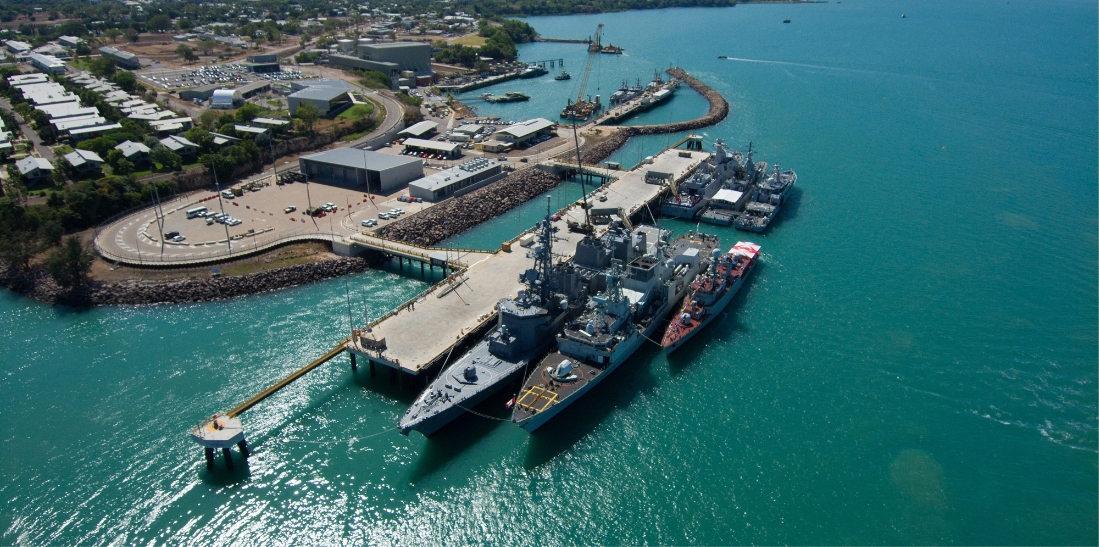
Physical delivery of infrastructure occurs predominantly on brownfield naval sites, where operational continuity is paramount. Sansbury defines the core requirements. “Constructability, can it be built in a live environment? You don’t want to switch the power off and send everybody somewhere else. Staging obviously refers to the sequence or the order in which you can do these things.”
Priorities include minimising disruption to existing submarine and fleet operations, optimising within budget and schedule parameters, and upholding safety as non-negotiable.
Western Australia’s HMAS Stirling has already hosted visits such as HMS Anson, providing early practical experience for Australian maintainers. Plans for a dedicated east coast submarine base introduce additional challenges, given the region’s higher development density and stakeholder complexity.
Lay-down areas are at a premium, necessitating innovative solutions such as temporary materials-handling corridors. Waywell stresses the importance of interface management. “It’s about managing those interfaces with existing facilities. It’s got to be really closely managed, and everyone’s got to be on the same page.”
Fogel, drawing on extensive US shipyard experience, describes the coordination required. “A lot of communication, scheduling, changing of traffic patterns, letting everybody know when utility outages are happening.”
Utilities, including electrical power, water, sewerage, stormwater and communications, must be staged without compromising vessel support. Security stand-off distances, controlled access zones and mechanical handling systems must be integrated from the conceptual stage.
While the US contends with ageing facilities dating to pre-revolutionary times, Australia’s relative greenfield opportunities within brownfield envelopes allow purpose-designed solutions that can incorporate modern standards from the outset.
The land-based infrastructure itself does not house the reactor; as Sansbury notes, the propulsion plant remains contained within the submarine “like a kettle in the water”.
Consequently, the focus is on supporting functions: controlled storage of low-level radioactive waste with full chain-of-custody tracking, wastewater processing facilities, reliable utility supplies and continuous radiological surveying. Fogel says: “You build special facilities where you store it in, you know where it is, you trace it, you track it. You make sure that you have your proper security posture. And then you do real-time surveys.”
Advantage, Australia
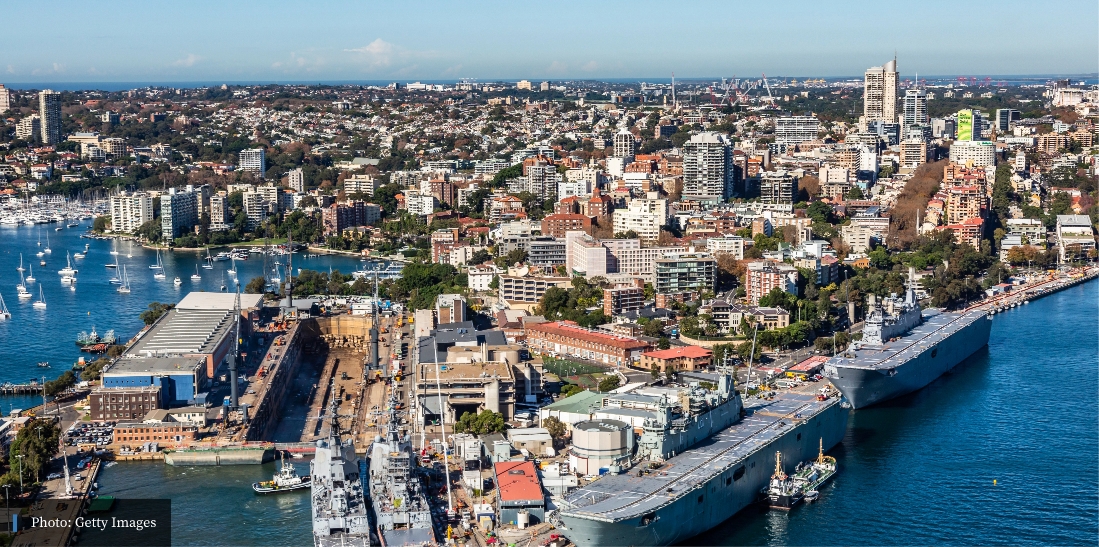
Australia’s lack of legacy nuclear infrastructure constitutes a significant opportunity to avoid historical pitfalls. Sansbury describes it as “a double-edged sword”; while public and regulatory caution can lead to over-engineering, access to seven decades of US and UK experience enables evidence-based decision making.
At each design milestone, Australian teams benefit from interrogation by senior US and UK colleagues who can identify downstream maintenance issues that would otherwise remain unforeseen.
Meanwhile, Fogel highlights how US programs have progressively lowered radiation exposure through improved reactor design, shielding and maintenance protocols. “All of that gets to be introduced into the Australian system.”
This blank slate advantage extends to whole-of-life sustainability. New facilities can be engineered for longevity, incorporating lessons on material selection, accessibility and operational efficiency that older yards have retrofitted at considerable cost.
The reactor’s inherent mobility contained within the vessel further simplifies land-side risk management, allowing the nuclear footprint to be deliberately minimised and tightly controlled.
Stantec’s cross-border integration accelerates this transfer. Sansbury has observed that every Australian design milestone undergoes rigorous peer review, shortening development timelines and enhancing safety.
The result is infrastructure that is not only compliant with international non-proliferation obligations but optimised for sovereign operation within the AUKUS framework.
Baking in ‘interoperability’
Trilateral interoperability represents both a technical challenge and a collaborative opportunity.
Sansbury defines it as “the architecture that makes the whole AUKUS program work; the systems need to be seamless”, encompassing power frequencies, measurement standards, tooling, spare parts, documentation and maintenance procedures. While not requiring full interchangeability, compatibility is essential for vessels of different classes to berth and be supported across partner bases.
Existing UK and US facilities must adapt to accommodate additional AUKUS submarines, whereas new Australian infrastructure can be purpose-designed for multi-class compatibility. Waywell notes that “the Australian facilities will have the benefit of the opportunity to design for the different classes they expect to see. That’s slightly different with the existing facilities we’ve got in the UK and the US. All those little subtle intricacies can have a significant impact if you’re not on top of it.”
Fogel views the process positively. “I see the Australian Navy, the UK Navy, the US Navy sitting there trying to figure out how interoperability is going to work, working together to solve their problems. And in the end, we’re going to come up with a better solution.”
Unified facilities criteria developed by the US, alongside parallel UK standards, provide a foundational roadmap. Collaborative problem-solving among the three navies is already yielding technical and operational improvements that benefit each partner individually and collectively.
The path forward
Delivering nuclear-ready maritime infrastructure for AUKUS demands sustained commitment across multiple fronts: regulatory maturation, workforce scaling, public engagement and meticulous brownfield execution.
Challenges of cultural adaptation, risk perception and live-site constructability are real, yet they are mitigated by Australia’s access to allied expertise, modern design principles and purposeful planning.
The opportunities, leapfrogging historical lessons, designing for longevity and embedding interoperability by design positions Australia to develop a sovereign capability that enhances strategic deterrence while maintaining rigorous safety standards.
As Waywell emphasises, nuclear readiness ultimately returns to culture. “What it comes back to is that culture, that safety culture, that nuclear culture is embedded in all that.”
With infrastructure projects advancing in Western Australia and east coast planning under way, Australia is transitioning from conceptual partnership to tangible sovereign capacity.
The disciplined integration of allied knowledge, regulatory oversight and engineering excellence will determine whether the “junior cousin” emerges as a capable and confident contributor to the AUKUS enterprise.
Success will not only support the submarine program but strengthen Australia’s broader defence industrial resilience for decades to come.