

With increased presence, however, comes an unavoidable reality: once a USV is put in the water, it becomes a target and survivability becomes a defining measure of its operational credibility.
Naval leadership has been concerned about the safety and defence of uncrewed surface vessels (USV) for over two decades. The first operational deployment of a USV by the US Navy took place during an extended combat deployment to the Persian Gulf in 2003. Following the USS Enterprise Carrier Strike Group’s return to its base in Norfolk, Virginia, the US Chief of Naval Operations (CNO) and his staff received the detailed post-deployment brief. The CNO‘s first question was about the USV, wanting to know if it had been taken, lost or attacked on deployment. Thanks to proper planning, it did survive the cruise and safely returned to Norfolk for follow-on tasking.
Two decades on, concerns around the defence and survivability of USVs continue to be relevant as a key-defining measure of their operational value. Locally, the Royal Australian Navy’s Surface Fleet Review (SFR), published in 2024 – Enhanced Lethality Surface Combatant Fleet – indicated the RAN intended to field six large optionally manned surface vessels or LOSVs in the 2030s to carry missile launch systems.
The loss of any vessel, whether crewed or uncrewed, is not something that any navy accepts lightly. Any loss at sea is a loss. Not only of capability, but of mission momentum and of scarce resources. This is where design matters. USV survivability deserves deliberate planning. Once USVs are spotted in the water, defence will quickly become a defining issue in operational contexts, where agility helps to preserve missions and deter opportunistic threats.
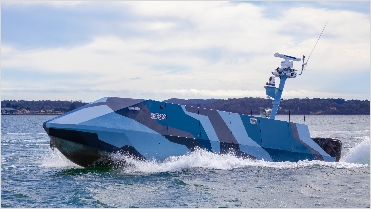
For that first USV deployed with the US Navy, the basic defence was speed and manoeuvrability, and that still applies today. Being able to evade targeting and avoid predictable patterns is key to survivability at sea. The Leidos Sea Archer USV offers a compelling example of survivability by design. With a top speed of 40 knots and the ability to execute rapid manoeuvres, Sea Archer can outrun almost any other vessel on the water, making its agility key to its primary defensive advantage. Slower systems are nearly defenceless.
The Leidos Sea Archer USV offers a compelling example of survivability by design.”
The second key to USV survivability is low observability which adds another layer to agility. This too is a design feature of Sea Archer. Sitting low in the water, sporting a disruptive paint scheme, with minimised radar cross section limits its detectability. With low electronic transmissions, it is designed to blend into the background of commercial maritime traffic.
The saying “there’s strength in numbers” also applies with USV teaming being another avenue for protection. Nature figured it out first. The most dangerous predator isn’t always the biggest, it’s the one with a partner. Think of the scene from Jurassic Park with raptors working together – it‘s a powerful example of coordinated effort and how lethal pairs can be. In a similar way, USVs currently in design and delivery are meant to work together on a variety of missions, including mutual self-defence.
Future defensive measures are also on the horizon for USV defences. Defense Advanced Research Projects Agency (DARPA) recently acknowledged this as part of the “Pulling Guard” program, intended to develop and demonstrate methods to enhance survivability of unarmed USV logistic vessels. Leidos has been awarded funding under the program, building on our experience with autonomous vessels in operational contexts. In follow on, the US Navy USV deployments, acoustic hailing devices were integrated to the platform to provide a second layer of defence. Finally, the integration of weapons such as loitering munitions and surface-to-surface missiles into USVs will provide key lethality needed to ensure defence and survivability.
For Australia, the implications are strategic. We are responsible for vast maritime approaches with a comparatively small naval asset base. We must do more with less, protect what we deploy and safeguard national interests across enormous distances. In this context, survivability by design is not optional, it is essential. Because in the end, the defence of USVs is about designing platforms that can survive long enough to matter. It’s about naval endurance, but more so, it is shaping which strategies succeed.